QL40-HM-453
Magnetic Susceptibility
Offered in two measuring ranges and resolves strata down to 25mm
Description
The QL40 HM-453 combines the magnetic susceptibility sensor from W&R Instruments and the ALT electronic interface. The probe is designed for measurement of magnetic susceptibility in open or plastic cased holes.
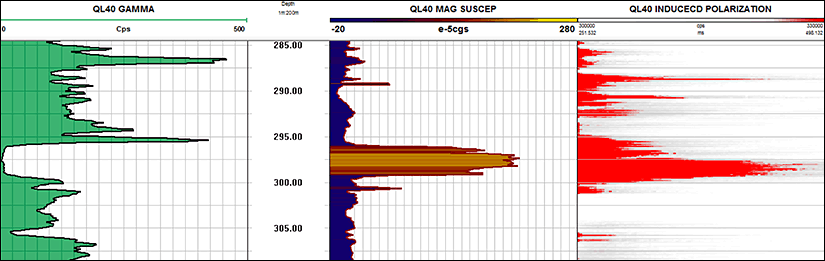
The magnetic susceptibility probe is generally used in mineral exploration and for stratigraphic correlations. It is ideal for characterising iron ores and for measuring the extension of ore bodies.
The operating frequency is chosen to be sufficiently low to avoid interference from rock conductivities and the circuitry is temperature compensated to minimize thermally induced drift. The QL40 HM-453 is offered with two measuring ranges and will resolve strata down to 25 mm.
The extended range is designed for measurements in complex igneous or metamorphic rocks up to high magnetite rocks. This extended range has been chosen so as to identify layers containing magnetite. These measurements are to be used for quantitative interpretation of the magnetic components in the rocks and estimation of the thickness of layers. In this way, the QL40 HM-453 can directly be used for economic evaluation of the deposit.
The QL40 HM-453 is supplied as a bottom sub. It can be combined with other logging tools of the QL (Quick Link) product line or it can be operated as a standalone tool. It is compatible with ALT/MSI acquisition systems.
Applications
- Mineral exploration and characterization
- Economic evaluation of deposits
- Lithology studies
- Extended range used in complex igneous or metamorphic rocks up to high magnetite rocks
- Ore Identification and quality correlation
- Delineation of kimberlite deposits for other logs
Downloads
Technical Specifications
Tool
- Diameter: 45 mm (1.77’’)
- Length: 1.44 m (56.7’’)
- Weight: 7 kg (15 lbs)
- Temp: 70 °C (158 °F)
- Max. Pressure: 200 bar (2900 psi)
Sensor
- Sensor: two coil system
- Intercoil spacing: standard : 25 cm - 30 cm
- Operating frequency: ~ 2 KHz
- Range-standard: 10E-5 to 0.5 SI units
- Range-extended: 10E-4 to 2 SI units)
- Accuracy: < 3% F.S.
- Drift-standard: < 2.10E-5 SI units/10°C
- Drift-extended: < 1.10E-4 SI units/10°C
Operating conditions
- Cable type: Mono, multi-conductor, coax
- Compatibility: Scout Pro / Opal (Scout / Bbox / Matrix)
- Digital data transmission Telemetry: Variable baudrate telemetry according to cablelength/type & surface system
- Logging speed: 5 m/min recommended
- Centralisation: Decentralized
- Borehole conditions: Dry or fluid-filled borehole Open or plastic cased borehole
Principle of measurement
The magnetic susceptibility – K is a dimensionless constant that indicates the degree of magnetization of a material in response to an applied magnetic field. When an inductor is placed within the influence of a rock sample, the relative permeability - μr of the rock sample determines the frequency of oscillation. Knowing the permeability of the free space - μ0 and relative permeability of the rock sample - μr the system can derive the value of magnetic susceptibility - K.
Measurements feature
Magnetic susceptibility in SI units