QL40-FTC-I / QL40-FTC-B
Fluid Temperature and Conductivity
Borehole fluid temperature and conductivity measurements
Description
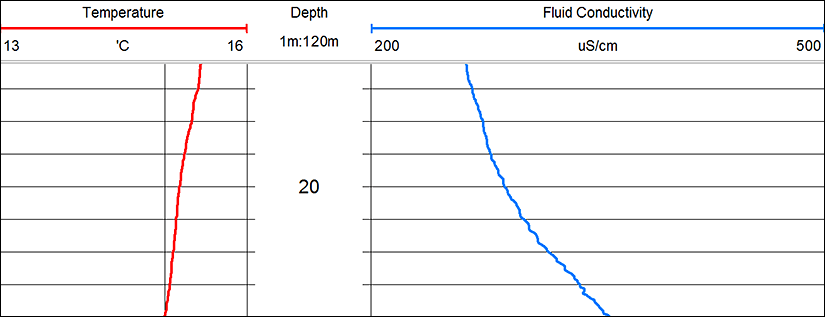
The QL40-FTC sub provides borehole fluid temperature and fluid conductivity measurements. In comparison with tools from competitors, the QL40-FTC is capable of recording a wide range of conductivity from fresh to highly saturated water.
The borehole fluid temperature measurement is helpful to detect anomalies caused by events such as fluid flow into the borehole. It is also used to normalize the conductivity measurement which is temperature dependent and so allowing comparisons between boreholes.
The borehole fluid conductivity is directly proportional to the concentration of dissolved minerals. It is generally used in hydrogeology to determine the concentration of dissolved ions in the aquifers and to locate the fluid flows occurring in the borehole.
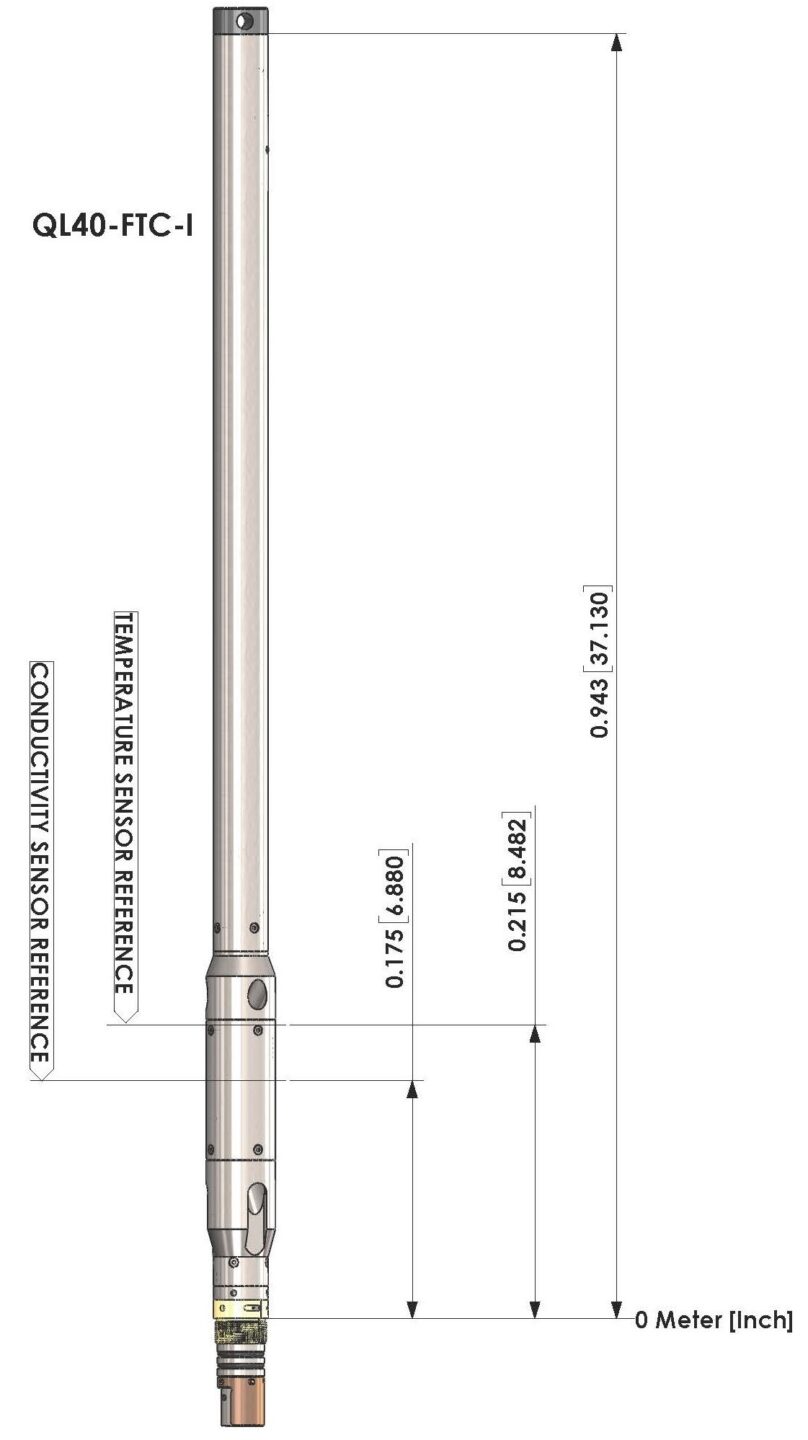
The QL40-FTC is available as a bottom or inline sub (QL40-FTCI). It can be combined with other logging tools of the QL (Quick Link) product line or can be operated as a standalone tool.
Applications
- Fluid conductivity – salinity
- Salt-water intrusion studies
- Identification of fluid flow in open/cased hole
- Localisation of the water table
- Localisation of water intervals of different quality
- Water-well monitoring
- Geothermal gradient logging
- Often used in the implementation of temperature compensation equations for other logs
Downloads
-
QL40-FTC Manual PDF
Technical Specifications
Tool
- Diameter
- Bottom sub : 40mm (1.6’’)
- In line sub : 50mm (2’’)
- Length
- Bottom sub : 0.78m (30.7’’)
- In line sub : 0.94m (37’’)
- Weight
- Bottom sub : 3.3kg (7.27lbs)
- In line sub : 6.2kg (13.6lbs)
- Temp: 0 - 70°C (32 - 158°F)
- Max. Pressure: 200bar (2900psi)
Temperature measurement
- Range: -20 to 80°C
- Accuracy: < 1%
- Resolution: 0.004°C
Conductivity measurement
- Range: 5μS/cm to 2.5 x 10⁵ μS/cm
- Accuracy: 1% (500 – 2.5 x 10⁵ μS/cm)
Operating conditions
- Cable type: Mono, multi-conductor, coax
- Compatibility: Scout / Opal (ALTIogger / Bbox / Matrix)
- Digital data transmission Telemetry: Variable baudrate telemetry according to cable length/type & surface system
- Logging: Always run downwards as the first log in order to minimize the fluid disturbance
- Centralisation: Not required
- Borehole fluid: Open or cased hole
- Temperature measurement: dry or water filled borehole
- Conductivity measurement: water filled borehole
Principle of measurement
Borehole temperature is measured with a sensor based on a fast response semiconductor device whose output voltage changes linearly with temperature. The temperature sensor is located in a stinger at the top of the sensor body in the center of the three exit ports where the borehole fluid returns to the well bore. Borehole fluid conductivity is measured using a seven electrode mirrored Wenner array. The conductivity array is an internal cylindrical array open at the bottom of the probe. Borehole fluid passes by the array as the probe is lowered in the hole. The array is completely shielded from the outside borehole, so that only fluid conductivity is measured.
Measurements features
- Fluid temperature in °C
- Fluid conductivity in μS/cm or mS/cm
- Compensated conductivity at 25°C in μS/cm or mS/cm